

Mobile App Maintenance
Why Mobile App Maintenance Matters

Author- SEO Content Writer
Launching a mobile app is a milestone, but it is hardly the finish line. The real work begins the moment your app goes live. Bugs surface. Operating systems update. User expectations evolve. Competitors release newer, faster experiences. Without a structured approach to mobile app maintenance, even a well-built application can deteriorate quickly, losing users, revenue, and reputation. Industry data shows that the global average app uninstall rate stands at 45%, meaning nearly half of all installs result in a deletion. That number alone makes it clear that releasing and forgetting is not a viable product strategy.
Benefits of Regular Mobile App Maintenance
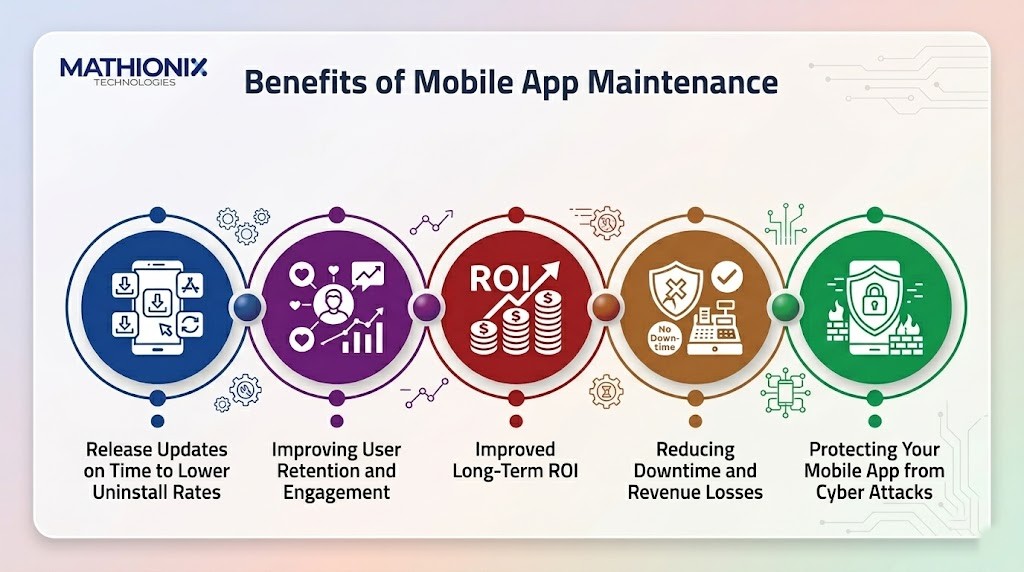
Regular application maintenance is not an overhead cost it is one of the highest-return investments you can make in your product’s longevity. Here is what it delivers in practice.
1. Release Updates on Time to Lower Uninstall Rates
Research consistently shows that more than 1 in every 2 apps installed on a device is uninstalled within the first 30 days. A high uninstall rate is almost always a signal that the app failed to meet user expectations in performance, stability, or relevance. Timely updates address exactly these gaps fixing crashes, improving load speed, and adding functionality users are asking for. Apps that maintain consistent update schedules tend to see meaningfully higher organic download rates compared to infrequently updated alternatives. When users see that an app is actively maintained, they are more willing to give it a second chance after a friction-filled experience.
2. Improving User Retention and Engagement
User retention and application maintenance are deeply connected. When an app runs smoothly, responds quickly, and incorporates feedback, users have fewer reasons to leave. Industry analysis consistently shows that well-maintained apps achieve significantly higher user retention rates and generate substantially more lifetime revenue compared to neglected applications. The reasoning is straightforward: users stay with products that continue to improve. Apps that ignore user feedback, fail to fix known bugs, or stop releasing updates communicate one thing to their audience that the product is no longer a priority. That perception is extremely difficult to reverse once it takes hold.
3. Improved Long-Term ROI
The financial case for consistent app maintenance services is compelling. Industry benchmarks widely agree that annual maintenance typically costs between 15% and 25% of the original development budget. On a $100,000 app, that translates to roughly $15,000–$25,000 per year. Skipping that investment does not eliminate costs it defers them, often at a much higher price. Technical debt accumulates silently, and a codebase that has not been touched in two years may require a near-total rewrite to add new features or achieve OS compatibility. Studies further indicate that well-maintained apps can generate returns of $74.60 for every dollar spent on production and maintenance over a seven-year lifecycle, making regular upkeep one of the most defensible line items in any digital product budget.
4. Reducing Downtime and Revenue Losses
Downtime is not just a technical inconvenience it is a direct hit to revenue. For eCommerce, logistics, and on-demand apps, every minute of unexpected outage translates to lost transactions and eroded user trust. Proactive maintenance catches performance bottlenecks, server overload risks, and dependency failures before they cascade into outages. This is especially critical for apps handling high-traffic windows like seasonal sales or product launches. A maintenance mobile app strategy built around monitoring and preventive intervention is far less costly than emergency response after a crash.
5. Protecting Your Mobile App from Cyber Attacks
Security is arguably the most urgent dimension of mobile app maintenance. Research shows that over 75% of published apps contain at least one security vulnerability, and unpatched flaws are involved in 60% of data breaches. Separate analyses put this figure even higher, with some studies noting that as many as 85% of mobile apps carry security or privacy vulnerabilities. Mobile malware incidents crossed the 33 million mark in 2024 alone. The message is unambiguous: an unmaintained app is not just a poor user experience it is an open door. Regular security patches, encrypted data handling, and updated authentication practices are non-negotiable elements of responsible app maintenance services.
Types of Mobile App Maintenance
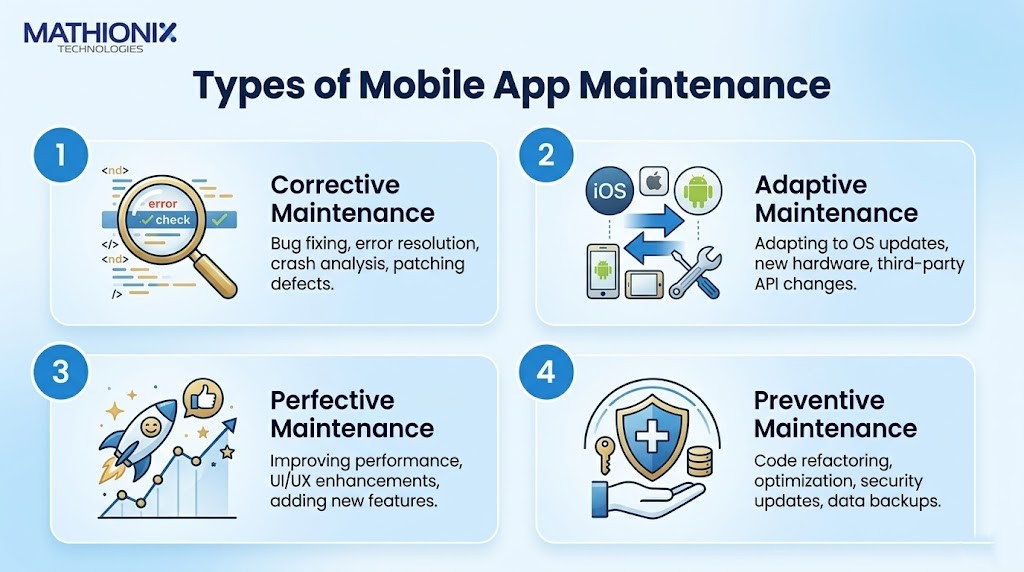
Not all maintenance activities serve the same purpose. Understanding the different software maintenance types helps teams prioritize correctly and allocate budgets where they matter most.
1. Corrective Maintenance (Bug Fixes)
Corrective maintenance is reactive by nature it involves identifying and resolving bugs, errors, and unexpected behaviors that surface after launch. These can range from minor UI glitches to critical crashes affecting core functionality. Fixing bugs and addressing security vulnerabilities typically consumes 20–30% of a maintenance budget, a figure consistently cited across industry cost analyses. While corrective maintenance cannot be avoided entirely, a well-architected codebase with thorough QA processes can significantly reduce how frequently it is needed.
2. Adaptive Maintenance (OS & Platform Updates)
Mobile apps must continuously adapt to new versions of iOS and Android, along with evolving device specifications, screen sizes, and hardware features. Both major mobile platforms release OS updates annually, and apps that do not respond to these changes risk compatibility failures or removal from app stores altogether. Adaptive maintenance also covers updates to third-party SDKs, APIs, and libraries that your app depends on. When a payment gateway changes its API or a mapping service updates its SDK, your app needs to respond quickly. Industry estimates put OS compatibility maintenance costs between $3,000 and $8,000 per year depending on how many platforms and device variants need to be supported.
3. Perfective Maintenance (Performance Optimization)
Perfective maintenance focuses on improving what already works faster load times, smoother animations, reduced battery consumption, and better UI/UX. This type of application maintenance is driven by user feedback, analytics data, and competitive benchmarking. It is not about fixing what is broken but about raising the bar for what good looks like. As user expectations evolve with every generation of smartphones and every competitor release, standing still is effectively moving backward. Perfective maintenance is the mechanism that keeps your app feeling modern and responsive even years after its initial launch.
4. Preventive Maintenance (Security & Code Health)
Preventive maintenance is the most forward-thinking of the four software maintenance types. It involves proactively auditing the codebase for technical debt, running security penetration tests, renewing SSL certificates, reviewing data encryption practices, and ensuring compliance with regulations like GDPR or HIPAA. The goal is to eliminate vulnerabilities before they become exploits and to keep the code architecture clean so future development remains cost-efficient. Research indicates that mobile app vulnerabilities contributed to approximately 40% of data breaches involving personal data, underscoring just how much is at stake when this type of maintenance is neglected.
Mobile App Maintenance Best Practices
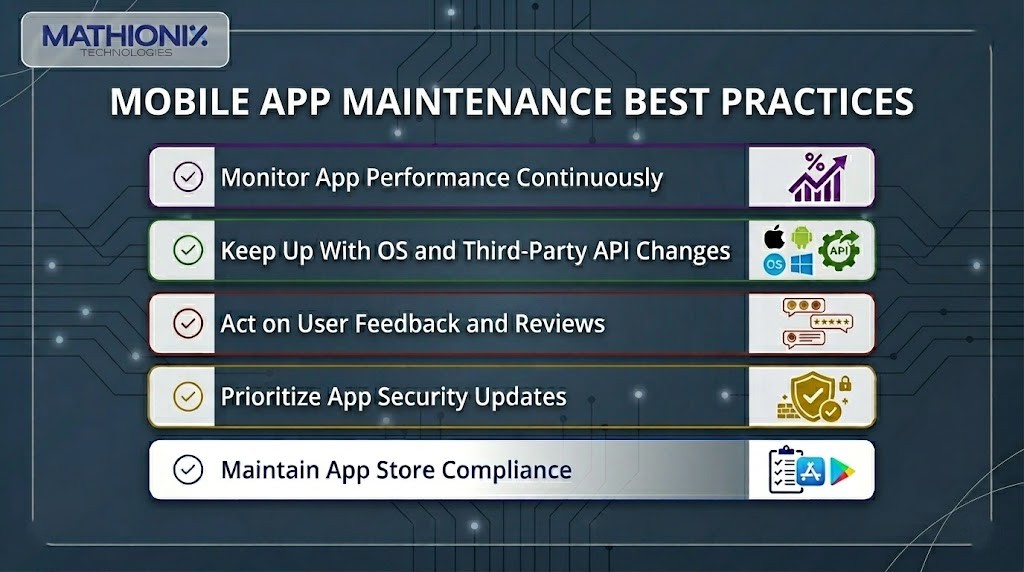
Knowing why maintenance matters and what types exist is useful but execution is everything. These are the practices that separate apps that stay relevant from those that quietly fade away.
1. Monitor App Performance Continuously
Continuous monitoring is the foundation of any effective maintenance mobile app program. A range of performance monitoring tools exist that provide real-time visibility into crash rates, API response times, and user flow drop-offs. Rather than waiting for a one-star review to flag a problem, monitoring surfaces issues at the moment they emerge often before the majority of users even notice. Teams should track both technical metrics like ANR rates and user-facing metrics like session length and task completion rates to get a full picture of where the app stands at any given time.
2. Keep Up With OS and Third-Party API Changes
Both major mobile platforms publish developer release notes well in advance of major OS versions. Treating these announcements as a maintenance calendar not a surprise allows teams to plan compatibility testing and code adjustments without rushing. The same principle applies to third-party integrations. Payment processors, analytics platforms, and mapping services regularly deprecate older API versions. An app that still relies on a deprecated API version is both a security risk and a ticking compatibility issue. Scheduling quarterly reviews of all active integrations is a straightforward best practice that prevents expensive emergency fixes.
3. Prioritize App Security Updates
Security patches should never be deprioritized in favor of feature work. The cost of a data breach in both financial terms and user trust is almost always greater than the cost of the patch that would have prevented it. The average cost of a data breach now stands at $4.88 million globally, according to industry research. At Mathionix, security is treated as a continuous activity, not a periodic audit. Routine penetration testing, dependency vulnerability scans, and encryption reviews should be built into every sprint cycle, not saved for a quarterly clean-up.
4. Act on User Feedback and Reviews
App store reviews are one of the most direct and underutilized data sources in mobile product management. Users who take the time to leave a review positive or negative are giving you a real-time signal about what is working and what is not. Incorporating a structured process for reviewing feedback, categorizing it by theme, and routing actionable items into the development backlog is a low-cost, high-value practice. Apps that visibly respond to user feedback fixing reported issues and acknowledging suggestions in update notes also tend to recover app store ratings faster after dips, which directly impacts organic discoverability.
5. Maintain App Store Compliance
Both major app stores update their developer guidelines regularly, and apps that fall out of compliance risk rejection during updates or removal from the store entirely. This includes privacy policy requirements, data handling disclosures, age-rating accuracy, and adherence to in-app purchase policies. Keeping a compliance checklist updated alongside each policy update cycle ensures that your app is never caught off guard during a review. For apps in regulated industries like healthcare or fintech, compliance maintenance extends beyond the app stores to include GDPR, HIPAA, and PCI DSS requirements, each of which carries its own review cycles and enforcement consequences.
Final Thoughts
Mobile app maintenance is not a background task it is a core product discipline. Every update you skip, every security patch you defer, and every piece of user feedback you leave unaddressed is a small decision that compounds over time into a much larger problem. The apps that continue to grow users, revenue, and trust years after launch are the ones where maintenance is treated with the same seriousness as the original build.
Whether you are dealing with a growing backlog of bugs, preparing for a major OS update, or simply trying to establish a reliable maintenance cadence for the first time, getting the right support in place makes all the difference.
Talk to Mathionix Technologies about a maintenance plan built around your app’s needs. Our team has helped 50+ enterprise clients keep their applications secure, fast, and future-ready. Get in touch today.
Grow Your Business with Custom Mobile App Solution by Mathionix
Related Articles for You


Frequently Asked Questions About Mobile App Maintenance
What is mobile app maintenance?
Mobile app maintenance is the ongoing process of updating, monitoring, securing, and optimizing a mobile application after it has been launched. It covers everything from bug fixes and OS compatibility updates to performance improvements, security patches, and feature additions based on user feedback. It is not a one-time activity but a continuous practice that runs parallel to the life of the product.
Is mobile app development different from mobile app maintenance?
Yes, and the distinction matters. Mobile app development is the process of building the application defining features, writing code, designing interfaces, and launching to the app stores. Maintenance, on the other hand, is everything that happens after launch to keep the app stable, secure, and competitive. Development is project-based with a defined endpoint. Maintenance is ongoing and open-ended. The skill sets overlap but are not identical, which is why many teams choose to work with dedicated app maintenance services providers rather than treating post-launch support as an afterthought of the development engagement.
When to Hire a Mobile App Maintenance Service?
The right time to think about maintenance services is before launch, not after a crisis. Ideally, you establish a maintenance agreement as part of your overall product roadmap so there is no gap between go-live and ongoing support. That said, there are clear signals that indicate an app needs professional maintenance attention: rising crash rates, declining app store ratings, failed submissions due to policy violations, performance degradation on newer devices, or the discovery that key integrations are running on deprecated APIs. If your internal team lacks the bandwidth or expertise to address these systematically, working with an experienced maintenance partner is the practical solution.
How Much Does App Maintenance Cost?
The most widely cited industry benchmark is 15–25% of the original development cost annually. For an app that cost $100,000 to build, that means budgeting $15,000 to $25,000 per year for maintenance. Monthly, this typically translates to $500–$5,000 depending on complexity, number of platforms, third-party integrations, and how actively the app is being improved. Simpler apps with minimal integrations sit at the lower end, while complex healthcare, fintech, or eCommerce apps with high security and compliance requirements tend toward the higher end. Mathionix offers flexible app maintenance service models from dedicated team retainers to milestone-based engagements so you can structure ongoing support in a way that aligns with your roadmap and budget.