
The world of product development has changed dramatically. Cross-functional teams can now complete tasks that traditionally took months of devoted work in a matter of days or even hours. This isn’t hyperbole; rather, it’s the new reality that the industry is seeing as AI tools transform each step of the development process.
Today, AI in product development is no longer experimental — it has become a competitive necessity. Businesses using AI for product development are accelerating innovation, reducing risk, and launching smarter solutions faster than ever before.
We at Mathionix Technologies have personally observed this change. Instead of deploying digital goods in quarters, teams are now doing so in weeks. Without large engineering teams, founders with little technical experience are launching complex products. Additionally, by integrating AI into their development processes, well-established businesses are significantly speeding up their innovation cycles.
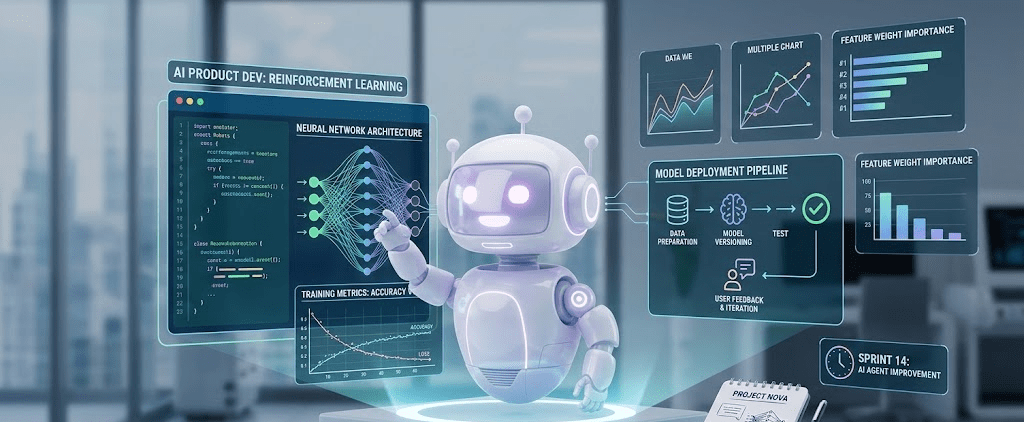
Product managers and development teams can now use AI’s capabilities to improve procedures, learn more about consumer behaviour, and innovate more quickly thanks to its integration into the product development lifecycle. From AI for product design to predictive decision-making, organisations are redefining how modern products are built. The main advantages of employing AI product development strategies for businesses are listed below.
The final product is improved when quality is regularly verified throughout the development lifecycle using AI tools. With its ability to standardise builds, simulate and test prototypes, identify problems early, and make data-driven decisions, artificial intelligence (AI) helps prevent mistakes and ensure high standards.
Modern AI product design tools further enhance accuracy by analysing patterns and suggesting structural improvements before physical production begins.
The ability of AI to significantly accelerate repetitious manual operations at every stage of product development may be its most significant benefit. Now, laborious operations are nearly instantaneous, from providing quick analysis of massive datasets to producing several design iterations in seconds.
The outcome? With advanced product development AI solutions, teams can generate ideas, produce more goods, and launch them more efficiently than ever before.
AI supports sustainability efforts by assisting teams in minimising waste and optimising the usage of raw materials throughout the product development lifecycle. Predictive AI models offer precise evaluations of a product’s probable environmental impact and recommend design or production modifications to enhance it.
A recent study found that the utilisation of materials was reduced by 84% as a result of AI-enhanced industrial automation. Additionally, it achieved a 90% weight reduction, which might result in a three-ton annual decrease in CO2 emissions per made item.
AI eliminates errors and expedites the development process, which lowers expenses. By anticipating design problems, machine learning technologies can save money on rework and material waste. Predictive analytics avoids expensive overproduction and delays, while accurate digital models can reduce prototype and testing costs in addition to replacing physical trials. These optimisations collectively result in considerable cost savings.
At Mathionix, we create customised AI solutions to meet the particular needs of teams working on product development. In order to help product development teams use AI for better decision-making, increased consumer engagement, and optimised product strategy, we offer strategic AI/ML consultancy.
Our proficiency in creating Proof of Concepts (PoCs) and Minimum Viable Products (MVPs) enables businesses to observe the possible effects of AI technologies in actual situations, guaranteeing that the solutions are efficient and customised to the particular requirements of product development. Additionally, our work in generative AI automates repetitive procedures like prototype testing and design iteration, freeing up product developers for more strategic roles.
Artificial intelligence comes in a variety of forms, and each one contributes to better product design and development.
ML enables computers to learn from massive information in order to forecast results, spot patterns, and gradually enhance decision-making. Machine learning (ML) can be used in product design and development to predict demand, optimise parameters, or identify defects early in the manufacturing process.
This type of AI can comprehend and interpret human language, as the name implies. It can be used to monitor sentiment, analyse client feedback, and even create organic product descriptions.
GenAI generates new designs or content using data and algorithms. Naturally, this can be quite helpful in development since it can generate design modifications or innovative product ideas very quickly.
Anticipating future developments is a crucial part of developing new products. Predictive analytics helps organisations make proactive decisions by combining data and statistical modelling to forecast future outcomes (such as material behaviour, market shifts, or maintenance needs).
A wide range of AI-driven trends that promise revolutionary effects are emerging as we traverse the future of product development. The future of artificial intelligence (AI) in product development is expected to bring about a number of revolutionary changes, such as:
A revolutionary movement that has the potential to completely alter the parameters of design and creative processes is multidimensional printing. This technology paves the way for the mass manufacture of complex goods and products by enabling virtual creations to become real-world items. These developments in printing technology portend a day when innovation will be able to explore previously unimaginable avenues, opening up new avenues for product development.
Innovative ideas can be generated on their own by incorporating generative AI algorithms into the creative process. This development will expand design options and revolutionise conventional methods of product development.
People without a background in computer programming can design basic apps using low-code and no-code software platforms. AI is bringing substantial improvements to these systems.
Low-code and no-code platforms are being used by non-programmers to create more complex applications at a lower cost. This year, 70% of new enterprise apps will be developed on low-code and no-code platforms, a 25% increase over the previous five years, according to a recent report.
AI product development is the process of using artificial intelligence like machine learning, natural language processing, and automation to build, improve, or power a product. It involves integrating smart algorithms into the software development lifecycle to support the AI product development process, helping teams brainstorm ideas, write code faster, predict user needs, and automate quality testing.
AI speeds up the entire development lifecycle by automating repetitive tasks, such as generating initial code and running thousands of automated tests. It also uses predictive analytics to analyze market trends and user feedback, ensuring that the product being built actually meets customer needs before it even launches.
AI significantly shortens the development lifecycle by accelerating every stage from ideation to launch. By automating repetitive tasks like code generation, bug testing, and data analysis, AI in product development allows teams to move through the “build-test-learn” loop much faster. On average, businesses integrating AI see a 30% to 50% reduction in time-to-market, enabling them to respond to customer needs and competitive shifts in near real-time.
© Copyright 2025 Mathionix Technologies Pvt Ltd. All rights reserved.