
Mobile App Development Trends
Top 15 Mobile App Development Trends 2026

Author- SEO Content Writer
The mobile app development trends 2026 are not just shaping how apps look they are redefining how apps think, behave, and deliver value. According to EIN Presswire, the global mobile applications market is currently valued at $206.6 billion in 2026 and is projected to reach $616.4 billion by 2033, expanding at a CAGR of 16.9%. With over 6.8 billion smartphone users worldwide, the pressure to build smarter, faster, and more personalized mobile experiences has never been higher. The decisions businesses and developers make today will directly determine which apps succeed and which ones become obsolete in the next three years.
What Is Mobile App Development?
Mobile app development is the process of designing, building, testing, and deploying software applications that run on smartphones, tablets, and other mobile devices. It covers everything from ideation and UX design to backend architecture, API integration, performance optimization, and post-launch maintenance. Modern mobile app development is no longer limited to native Android or iOS builds it now spans cross-platform frameworks, low-code environments, AI-powered development tools, and cloud-native architectures that allow a single team to ship across multiple platforms simultaneously.
Why Businesses Must Follow Mobile App Development Trends
Staying current with mobile app development trends is not optional it is a competitive necessity. User expectations evolve in direct response to what the best apps in the market are already doing. When one industry raises the bar on personalization, speed, or design, every other industry is expected to match it. Businesses that invest in trend-aligned development attract and retain more users, spend less on acquisition, and build products that are easier to scale. Those that ignore these shifts end up rebuilding from scratch at a far greater cost.
Top 15 Mobile App Development Trends to Watch in 2026
From on-device intelligence to multimodal interfaces and super apps, here are the 15 most important mobile app development trends defining what gets built and how in 2026.
1. AI-Native Mobile Applications
Artificial intelligence is no longer an add-on feature in mobile apps it is the foundation. AI-native apps are built from the ground up with machine learning models embedded into their core architecture, enabling real-time decision-making, contextual awareness, and adaptive behavior without requiring a server round-trip. In 2026, AI in mobile app development means apps that predict what users need before they ask, automate repetitive actions, and surface relevant information at exactly the right moment. According to Gartner, 40% of enterprise applications will incorporate task-specific AI agents by end of 2026, up from less than 5% in 2025 an eightfold increase that signals how fast AI is becoming embedded in production-grade mobile software. At Mathionix, AI development is a core competency, and we architect mobile products with intelligence built into every layer.
2. Hyper-Personalized User Journeys
Personalization in 2026 has moved far beyond showing users content they might like. Today, AI-driven personalization adapts the entire app experience interface layout, feature visibility, notification timing, and even tone in real time, based on individual behavioral patterns. A user who opens an app at 7am daily sees a fundamentally different experience than one who logs in weekly. The interface responds to how that specific person actually uses the product. This level of personalization directly drives retention and lifetime value. Mathionix builds personalization engines using on-device models and real-time behavioral signals, helping clients across healthcare, retail, and edtech create experiences that feel built for each individual user.
3. Privacy-First App Architecture

Privacy is now a product feature, not a legal footnote. With Apple’s App Tracking Transparency, Google’s Privacy Sandbox, India’s Digital Personal Data Protection Act, and tightened GDPR enforcement all active in 2026, apps that treat data protection as an afterthought risk rejection from app stores, regulatory penalties, and user churn. Privacy-first architecture means apps collect only the data they genuinely need, store sensitive information in hardware-backed secure enclaves, and implement differential privacy techniques to ensure individuals cannot be identified from analytics data. Apps that communicate their privacy approach clearly through transparent permission flows and accurate App Store labels are consistently rated higher and downloaded more than those that don’t. For Mathionix, privacy engineering is scoped into every project brief from day one, not retrofitted at launch.
4. On-Device AI & Edge Computing
On-device AI is one of the most transformative mobile app development trends in 2026. Rather than sending user data to a remote server for processing, on-device intelligence runs inference directly on the phone’s chip using Apple’s Neural Engine on A18-series devices, Google’s Tensor G4, or Qualcomm’s Snapdragon AI Engine. The result is sub-millisecond response times, full offline capability, and privacy by default, since sensitive data never leaves the device. This is the architectural backbone behind Apple Intelligence and Gemini Nano. For developers, it means integrating frameworks like Core ML, TensorFlow Lite, ML Kit, and ONNX Runtime to ship AI features that work anywhere in an elevator, on a flight, or in areas with zero connectivity. On-device AI and edge computing are converging to create a new class of mobile experience that is faster, smarter, and more trustworthy than anything cloud-only approaches can deliver.
5. Multimodal Interfaces
Voice, touch, gesture, camera, and text are no longer separate input modes they are converging into unified multimodal interfaces that allow users to interact with apps in the most natural way available to them in any given moment. Voice-enabled apps are growing rapidly as large language models make natural language understanding genuinely reliable on mobile. Users can now speak commands, switch to touch when in a quiet environment, and use the camera to interact with the physical world all within a single app session. This trend is particularly significant in accessibility, hands-free scenarios, and markets where typing on a small screen is a friction point. Building for multimodal input from the start, rather than adding voice as a bolt-on, is what separates genuinely modern apps from surface-level implementations.
6. UX-Led UI Design
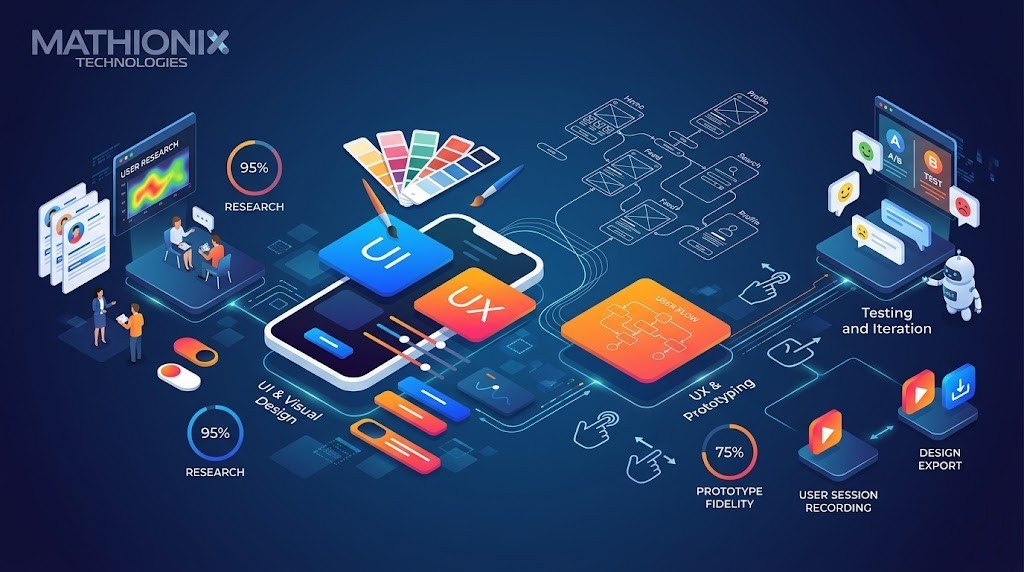
In 2026, the best mobile interfaces are not designed to impress they are designed to disappear. UX-led UI design means every visual decision is justified by how it serves user behavior, not by aesthetic preference. Navigation patterns follow the natural reach zones of one-handed use. Colour and contrast are optimized for accessibility across lighting conditions. Onboarding flows are shortened to the minimum number of steps needed to deliver first value. This shift away from decoration toward function is being driven by data teams that rigorously test and iterate based on session recordings, heatmaps, and drop-off analytics consistently outperform those that rely on instinct. The result is apps that feel effortless, reduce cognitive load, and convert users from curious visitors into loyal customers.
7. Smart Offline Experiences in Mobile Apps
Connectivity is still not guaranteed and the apps that perform flawlessly offline or on poor networks earn measurably stronger retention than those that break when the signal drops. Smart offline experiences go beyond simple caching. They involve intelligent background sync, local-first data architectures, and conflict resolution logic that ensures users never lose their work, even when connectivity is intermittent. As on-device AI becomes more capable, offline mode is no longer just about reading cached content it means full feature availability including AI-powered recommendations, form submissions queued for sync, and real-time document collaboration that merges changes seamlessly once a connection is restored. This trend is especially important for apps targeting emerging markets, healthcare settings, and enterprise field teams.
8. Computer Vision & Camera-First Experiences
The smartphone camera has evolved from a photo-capture device into a real-time intelligence engine. Computer vision in mobile apps now powers instant product recognition in retail, AR-guided physiotherapy in healthcare, quality inspection in manufacturing, document scanning with structured data extraction, and live translation of text in any language. Frameworks like ARKit 6 on iOS, ARCore on Android, Google’s ML Kit, and Apple’s Vision framework have made it possible to build production-grade computer vision features without specialized ML expertise. In 2026, apps that use the camera as a primary input mechanism rather than treating it as a secondary feature are creating interaction paradigms that are faster and more intuitive than any keyboard or touch interface can match.
9. Low Code / No Code App Development

Low-code and no-code platforms are reshaping who can build mobile apps and how quickly they reach production. According to industry analysis, by 2026 approximately 75% of new enterprise applications will be built using low-code tools up from 25% five years ago. Platforms like FlutterFlow, Bubble, and Appsmith are enabling non-developers to prototype and ship functional apps in days rather than months. The critical distinction is where low-code ends and expert engineering begins. Simple workflows, onboarding screens, and dashboards can be generated rapidly with these tools. But complex backend logic, AI integration, security architecture, and performance optimization still require experienced mobile developers. Low-code platforms are multiplying developer productivity Mathionix engineering teams use AI-assisted development tools across projects but they are not a replacement for deep platform expertise.
10. 5G-Powered & Network-Aware Apps
According to Ericsson’s Mobility Report, there are now 2.9 billion active 5G subscribers globally, and 5G has moved well beyond metro areas into tier-2 cities across India, the US, and Europe. For mobile app developers, this changes the baseline. 5G’s ultra-reliable low-latency communication (URLLC) enables latency as low as 1ms making app categories feasible that were simply not possible on 4G, including real-time multi-user AR, surgical robotics control via mobile, live AI translation in video calls, and cloud gaming with no perceptible input lag. Network-aware app architecture means apps dynamically adapt their behavior based on connection quality switching between on-device processing and cloud inference, adjusting media quality, and pre-fetching content intelligently when bandwidth is available. Apps that are built 5G-native rather than retrofitted will maintain a significant performance advantage.
11. Cross-Platform App Development
The question of whether to build native or cross-platform has largely been settled in 2026 for the vast majority of business applications, the answer is Flutter or React Native. Flutter has extended its lead for performance-critical, visually complex, and multi-platform applications. With the Impeller rendering engine closing the gap with native performance, Flutter’s single codebase delivering pixel-perfect results across iOS, Android, web, and desktop is now a production reality. React Native with the New Architecture (Fabric + JSI) has similarly resolved its earlier performance limitations, making it the right choice for teams with React expertise or apps deeply integrated with web infrastructure. Cross-platform development reduces cost, accelerates time to market, and simplifies maintenance critical advantages for businesses building across a fragmented device landscape. Mathionix delivers cross-platform mobile products using both Flutter and React Native, selecting the right framework based on each client’s technical context and product goals.
12. Super Apps Will Dominate
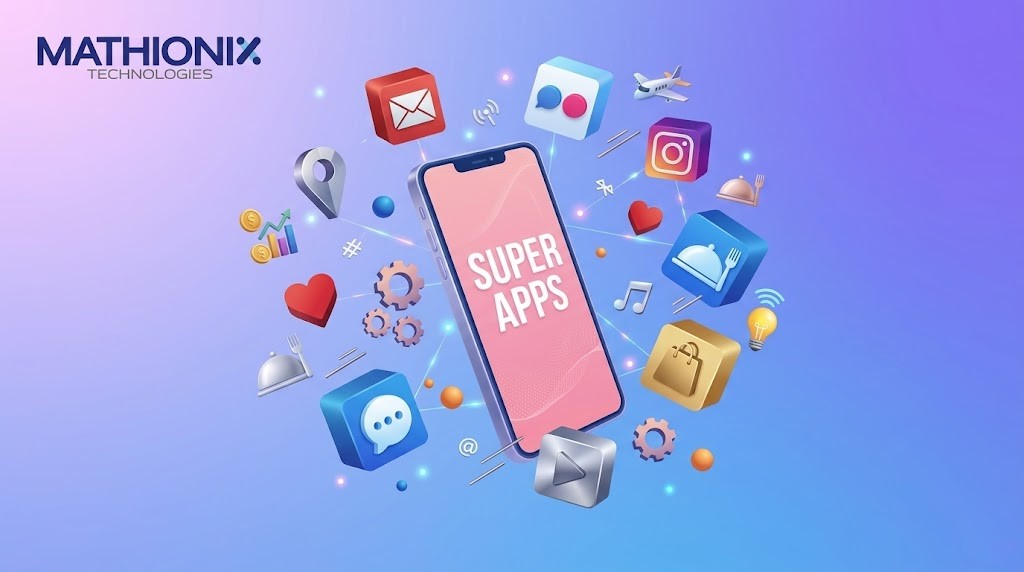
Super apps single platforms that combine messaging, payments, commerce, healthcare, and third-party mini-apps in one experience dominated Asia for years and are now a defining mobile app development trend globally. The economics are compelling: average session time in super apps is three to five times higher than in single-purpose apps, and the cost of retaining a user inside one platform is dramatically lower than re-engaging them across separate apps. In 2026, enterprise players like Salesforce and ServiceNow are building mini-app ecosystems into their mobile platforms, while consumer fintech apps in India and Southeast Asia continue to expand their service layers. The technical foundation for super app development modular architecture, dynamic bundling, and sandboxed mini-app execution is now achievable with Flutter and React Native at scale.
13. IoT & Wearable App Expansion
The intersection of mobile apps with IoT devices and wearables is one of the fastest-growing areas in the ecosystem. Smartwatches, fitness trackers, connected medical devices, smart home hardware, and industrial IoT sensors all rely on mobile apps as their primary interface and data hub. In 2026, wearable integration is moving from step-count dashboards to genuinely intelligent health monitoring apps that process biometric data continuously, flag anomalies in real time, and trigger contextual responses without requiring the user to open the app at all. The health and fitness application segment is expected to register the fastest CAGR through 2033, driven by growing consumer focus on preventive healthcare and the proliferation of wearable devices with increasingly sophisticated sensors.
14. Cloud Computing & Progressive Web Apps
Cloud-native mobile backend architecture and Progressive Web Apps (PWAs) are converging to give businesses more flexibility in how they deliver mobile experiences. Cloud computing allows mobile apps to offload heavy computation, scale infrastructure instantly based on demand, and deliver consistent performance globally through edge nodes close to users. PWAs, meanwhile, offer a compelling middle ground app-like experiences accessible via the browser, with offline capability, push notifications, and home screen installation, without requiring a presence in the App Store or Play Store. For businesses that need rapid deployment, lower distribution barriers, or a cross-platform footprint that includes the web, the cloud-plus-PWA stack is increasingly the right architectural starting point before committing to full native development.
15. AR, VR & Spatial Apps

Spatial computing has moved from a headset-only conversation to a mainstream mobile opportunity. ARKit and ARCore give the 6 billion smartphones already in market access to augmented reality capabilities enabling use cases across retail (virtual product try-on), healthcare (AR-guided physiotherapy and procedure support), real estate (virtual property staging), field service (AR overlay of maintenance manuals), and education (spatial 3D models for complex concepts). Apple Vision Pro and Meta Quest 3 have raised user expectations for spatial interaction, and that expectation is bleeding into how users judge mobile AR experiences. Apps that integrate AR meaningfully reducing a genuine friction point in the user journey rather than deploying it as a novelty show measurably better engagement and conversion metrics.
Final Thoughts
The mobile app development trends of 2026 are not independent features you can adopt one at a time. The most successful products in the market are combining several of them on-device AI that powers personalization, 5G architecture that enables real-time multimodal interaction, and privacy-first design that makes users trust the experience enough to share the data that makes it work.
At Mathionix, we build mobile products that are aligned with where the market is actually heading not where it was two years ago. Whether you are launching a new app, modernizing an existing one, or evaluating the right technology stack for a complex product, our team brings both the technical depth and the strategic perspective to make the right decisions from day one.
Ready to build a mobile app that is ahead of the curve? Contact Mathionix and let’s talk about what the right architecture looks like for your product.
Grow Your Business with Custom Mobile App Solution by Mathionix


Frequently Asked Questions About Mobile App Development Trends
How do mobile app development trends impact businesses in 2026?
Mobile app development trends directly determine whether a business’s product meets or falls short of current user expectations. When the leading apps in a category raise the bar on personalization, performance, or design, users apply that standard to every app they use. Businesses that align their development roadmap with current trends attract more users, retain them longer, and spend less on re-engagement. Those that don’t tend to see higher churn, lower store ratings, and escalating rebuild costs.
How do I choose the right mobile application development company?
The right mobile development partner should have demonstrated experience with the specific technologies your product requires not just familiarity with the framework names. Ask for examples of apps they have shipped using on-device AI, cross-platform frameworks, or the specific integrations your product needs. Evaluate their process for architecture decisions, their approach to privacy and security, and whether they treat your product roadmap as a long-term engagement or a one-off delivery. Mathionix works with businesses across healthcare, fintech, retail, and enterprise bringing both the technical and strategic expertise needed to build products that scale.
What are the biggest mobile app development trends in 2026?
The most impactful trends in 2026 are AI-native app architecture, on-device intelligence and edge computing, privacy-first design, cross-platform development with Flutter and React Native, and the rise of super apps. These trends are interconnected on-device AI enables privacy-first personalization, and 5G infrastructure makes real-time AI inference at the edge feasible at scale. Businesses that understand how these trends work together are making better architectural decisions than those tracking them in isolation.
What makes a mobile app successful in 2026?
A successful mobile app in 2026 solves a clear problem, delivers value within the first session, performs flawlessly across network conditions, and earns user trust through transparent privacy practices. It is built on an architecture that can evolve adding AI features, scaling infrastructure, or expanding to new platforms without a costly rewrite. The apps that succeed are those that combine strong technical foundations with continuous, data-informed iteration on user experience.
How much does mobile app development cost in 2026?
Mobile app development costs in 2026 vary significantly based on complexity, platform, team location, and the technologies involved. A functional MVP built on a cross-platform framework can range from $15,000 to $50,000. A full-featured product with AI integration, custom backend infrastructure, and multi-platform support typically ranges from $80,000 to $250,000 or more. Low-code tools can accelerate early-stage development and reduce costs for simpler workflows, but complex features still require experienced engineers. The most important factor is not the upfront cost it is whether the architecture chosen allows the product to grow without expensive rebuilds.
What programming languages are used in mobile app development in 2026?
In 2026, Swift remains the primary language for native iOS development, and Kotlin is the standard for native Android. For cross-platform development, Dart (Flutter) and JavaScript/TypeScript (React Native) are the dominant choices, with Flutter continuing to gain ground for its performance and multi-platform reach. On the backend, Python, Node.js, and Go are widely used for mobile APIs and AI/ML integration. Low-code platforms abstract away language choice for simpler use cases, but complex products still require developers who are fluent in the languages native to their target platform and framework.