

RAG GenAI
Why RAG Plays a Crucial Role in Generative AI

Author- SEO Content Writer
Modern AI systems often struggle with one critical limitation delivering outdated or inaccurate responses due to reliance on static training data. This is exactly where rag in gen ai transforms how intelligent systems operate by combining real-time data retrieval with advanced language generation.
Retrieval augmented generation (RAG), often referred to as rag in ai, is an approach that enhances AI models by enabling them to access external knowledge sources before generating responses. Instead of relying only on pre-trained data, a rag model dynamically retrieves relevant information and then uses it to produce more accurate, context-aware outputs.
At its core, rag based generative ai integrates two essential components: a retrieval system that fetches up-to-date information and a generation system that converts that data into meaningful responses. This combination allows AI systems to overcome the limitations of traditional models and deliver results that are not only relevant but also grounded in real-world data.
Importance of RAG in Generative AI
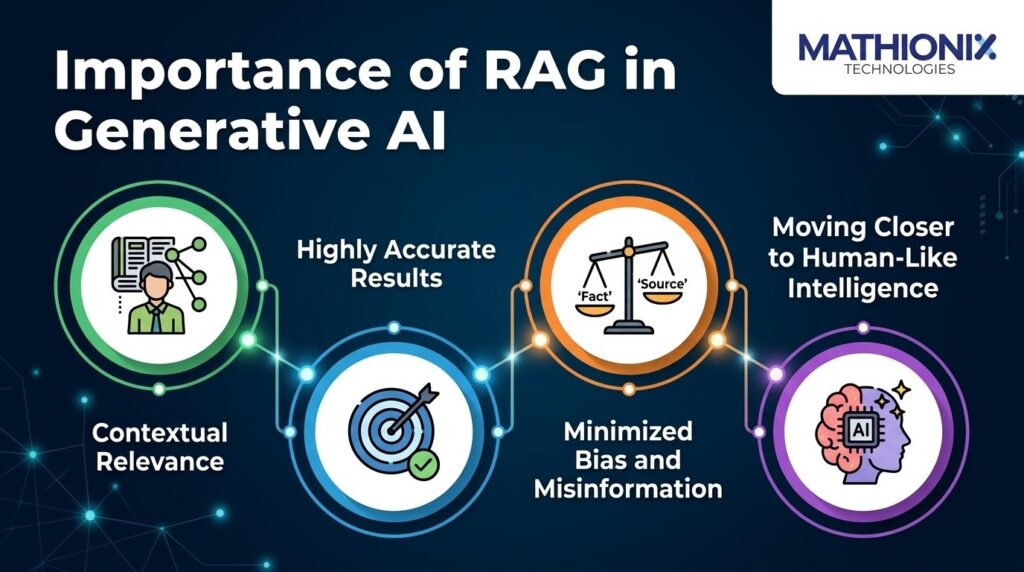
RAG plays a crucial role in improving how AI systems deliver accurate, reliable, and context-driven outputs.
Contextual Relevance
One of the biggest advantages of rag genai is its ability to provide contextually relevant responses. Traditional AI systems generate answers based only on training data, which may not always match the current context. In contrast, rag based ai retrieves real-time information, ensuring that responses align with the user’s query and current conditions.
Highly Accurate Results
Accuracy is a major concern in AI adoption, especially in industries like healthcare, finance, and legal services. By integrating external data sources, retrieval augmented generation significantly improves the precision of outputs. Since responses are supported by retrieved information, the chances of incorrect or misleading answers are greatly reduced.
Minimized Bias and Misinformation
AI models trained on static datasets can inherit biases or outdated perspectives. The rag architecture reduces this issue by pulling information from diverse and updated sources, helping generate balanced and fact-based responses. This makes AI systems more trustworthy and reliable for decision-making.
Moving Closer to Human-Like Intelligence
Human intelligence relies heavily on accessing and interpreting relevant information before responding. Similarly, rag in gen ai mimics this behavior by retrieving knowledge before generating answers. This approach enables AI systems to behave more like humans context-aware, informed, and adaptive.
Difference between RAG vs traditional AI
Traditional AI models rely entirely on pre-trained data, which means their knowledge is fixed and limited to what they have learned during training. This often leads to outdated responses and what is commonly known as “AI hallucinations,” where models generate incorrect or fabricated information.
On the other hand, a rag model enhances this process by introducing a retrieval layer. Instead of guessing or relying solely on memory, the system actively searches for relevant data from external sources such as databases, documents, or APIs. This makes rag based generative ai more dynamic, accurate, and adaptable.
Another major difference is scalability. While traditional models require retraining to update knowledge, rag architecture allows systems to stay current simply by updating the data sources they retrieve from. This significantly reduces maintenance efforts while improving performance.
Business Benefits of RAG in Generative AI
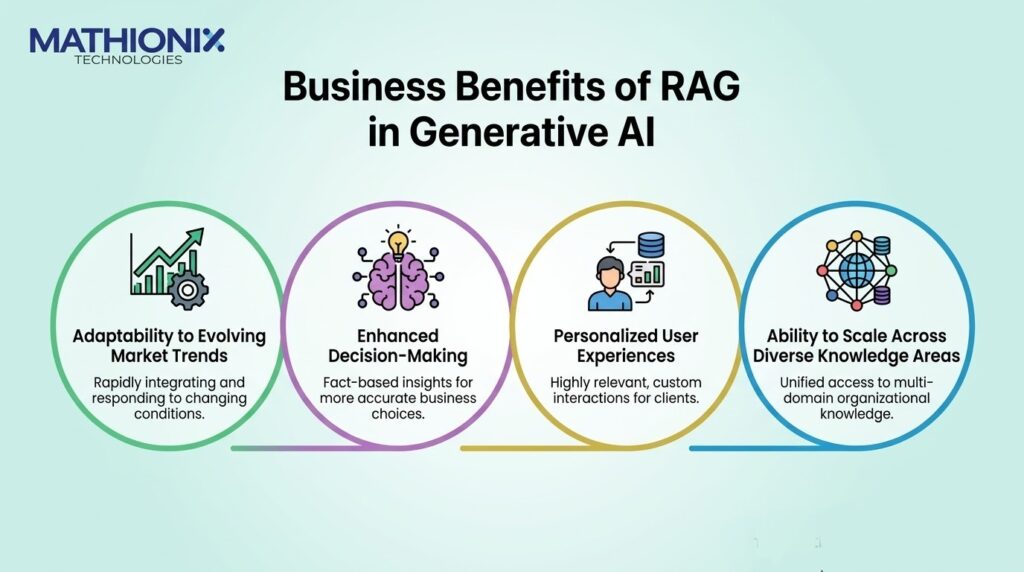
For businesses, the value of rag in gen ai goes beyond technical improvements and directly impacts efficiency, decision-making, and customer experience.
Adaptability to Evolving Market Trends
Markets change rapidly, and businesses need real-time insights to stay competitive. Rag based ai enables organizations to access up-to-date information, making it easier to adapt to new trends, regulatory changes, and customer demands without constantly retraining AI models.
Enhanced Decision-Making
Accurate data is the foundation of effective decision-making. With retrieval augmented generation, businesses can rely on AI systems that provide insights based on the latest information. This reduces uncertainty and allows leaders to make informed, data-driven decisions.
Personalized User Experiences
Customer expectations are constantly evolving, and personalization has become a key differentiator. Rag genai enables AI systems to deliver tailored responses by retrieving user-specific or context-specific data, improving engagement and customer satisfaction.
Ability to Scale Across Diverse Knowledge Areas
As businesses grow, they need AI systems that can handle diverse and expanding datasets. The flexibility of rag architecture allows organizations to integrate multiple knowledge sources, making it easier to scale AI capabilities across departments and industries.
Obstacles in Deploying RAG Solutions
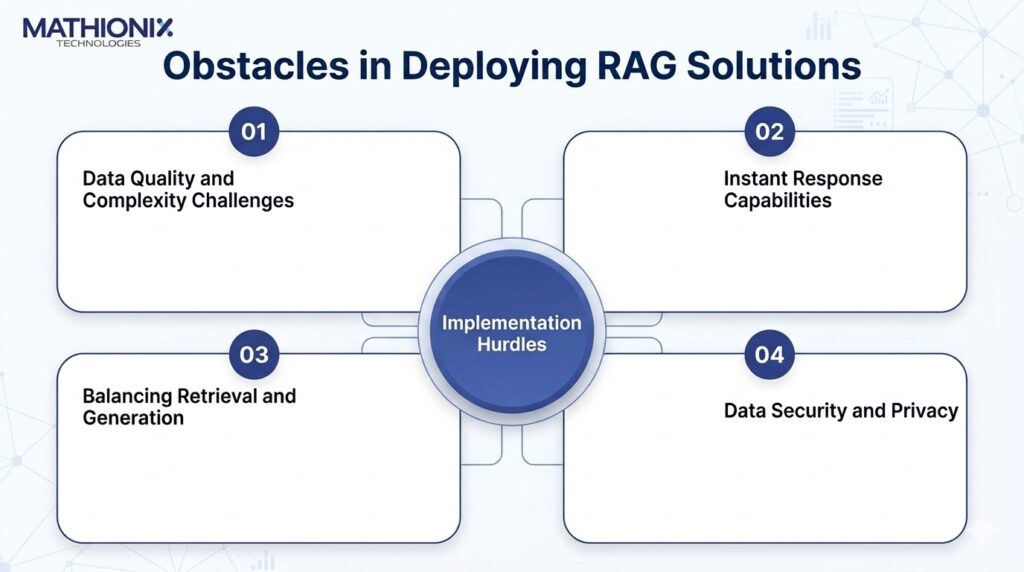
While rag based generative ai offers significant advantages, implementing it comes with certain challenges that businesses must address.
Data Quality and Complexity Challenges
The effectiveness of a rag model depends heavily on the quality of data it retrieves. Inconsistent, outdated, or irrelevant data can negatively impact results. Managing multiple data sources and ensuring their accuracy requires strong data governance strategies.
Instant Response Capabilities
Real-time retrieval can introduce latency, especially when dealing with large datasets. Ensuring fast response times is critical for applications like customer support or financial analysis, where delays can affect user experience.
Balancing Retrieval and Generation
A key challenge in rag in ai is maintaining the right balance between retrieving relevant information and generating coherent responses. If the retrieval process is inefficient or the generation model misinterprets the data, the output may lose clarity or accuracy.
Data Security and Privacy
Since rag based ai interacts with external data sources, it raises concerns about data security and privacy. Businesses must implement strict access controls, encryption, and compliance measures to protect sensitive information and maintain user trust.
future of GenAI RAG model

As AI adoption increases, rag in gen ai is expected to integrate with multimodal systems that combine text, images, and other data formats. This will expand its applications across industries such as healthcare, e-commerce, and education, enabling more advanced and context-rich outputs.
Another key trend is the improvement of rag architecture through faster retrieval mechanisms and smarter data indexing techniques. Technologies like vector databases and semantic search are already enhancing how AI systems access and process information.
Additionally, businesses are moving toward building custom rag based generative ai solutions tailored to their specific needs. This shift will drive innovation, allowing organizations to create AI systems that are more aligned with their goals, data, and workflows.
Conclusion
Rag in gen ai is redefining how businesses use artificial intelligence by combining real-time data retrieval with intelligent response generation. As organizations move toward more data-driven strategies, adopting rag based generative ai can significantly improve accuracy, efficiency, and decision-making.
To stay competitive in an evolving digital landscape, businesses need AI solutions that are not only intelligent but also adaptive and reliable. Partner with Mathionix to build powerful, scalable RAG-based AI solutions tailored to your business needs and unlock the true potential of next-generation AI.
Grow Your Business with Advanced RAG in Generative AI Solutions by Mathionix
Related Articles for You



Frequently Asked Questions
Is RAG the same as generative AI?
No, retrieval augmented generation is not the same as generative AI. It is an advanced approach within generative AI that enhances traditional models by adding a retrieval mechanism to improve accuracy and relevance.
What type of information is used in RAG?
A rag model uses both structured and unstructured data from sources such as databases, documents, APIs, and web content. The quality and relevance of this data directly impact the performance of the system.
How does generative AI use RAG?
Generative AI uses rag architecture by first retrieving relevant information from external sources and then using a language model to generate responses based on that data. This ensures outputs are accurate, contextual, and up-to-date.
What is the difference between RAG and semantic search?
Semantic search focuses on finding relevant information based on meaning and intent, while rag based ai goes a step further by using that retrieved information to generate complete responses. In simple terms, semantic search finds data, whereas RAG uses that data to create meaningful answers.