

Hire AI Developers
Business Benefits of an AI Developer for Companies

Author- SEO Content Writer
AI developers are no longer a luxury, they’re a core hire for any business that wants to stay competitive. They help you automate complex decisions, extract value from data, and build products that actually learn over time. According to the World Economic Forum, demand for AI roles is expected to exceed supply by 30 to 40 percent by 2027. The companies hiring now are locking in capability before the market gets harder. If your business handles large data, wants to automate workflows, or is building intelligent features, an AI developer is the person who makes it work.
Core Skills Required for Every AI Developer
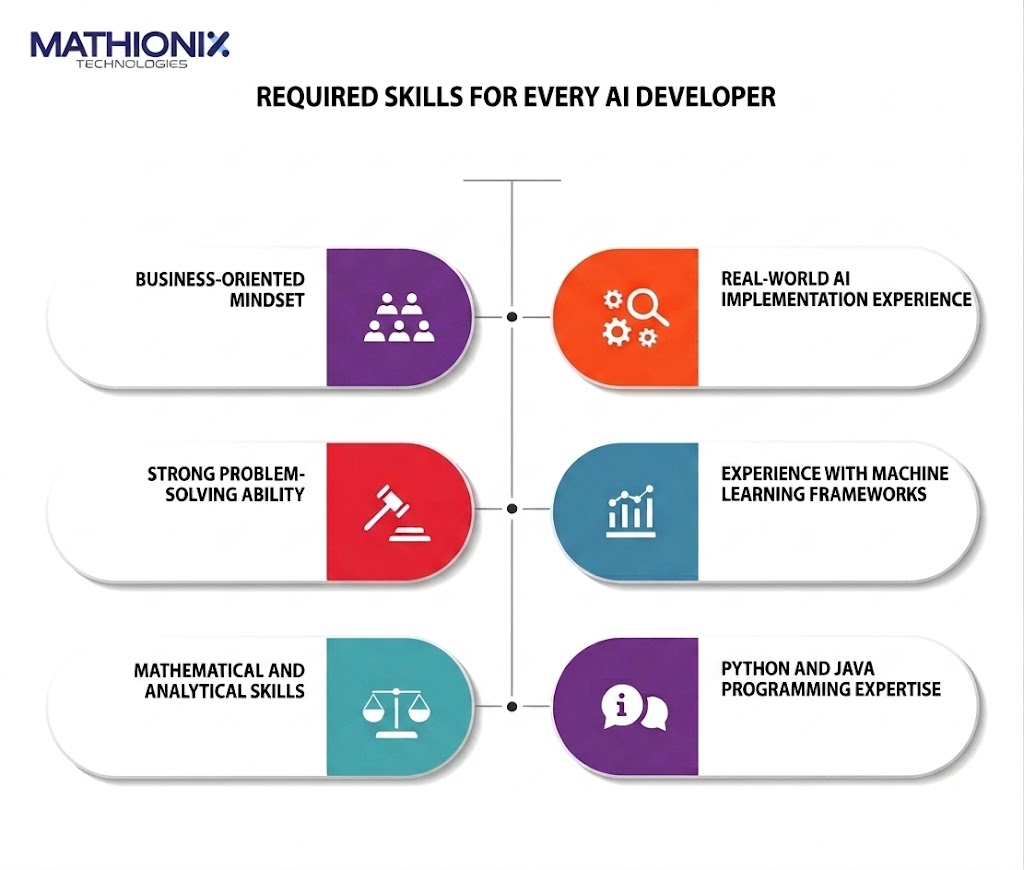
Knowing what to look for is half the battle when you decide to hire AI engineers.
1. Strong Problem-Solving Ability
AI development rarely follows a predictable path. Models behave unexpectedly. Data is messy. The best approach is often unclear until you’ve tested three others. What separates a strong AI developer from a mediocre one isn’t how much they know, it’s how they work through situations where the answer isn’t given. In interviews, look for candidates who can articulate specific challenges they encountered in previous projects and explain how they diagnosed and resolved them. That kind of structured thinking under uncertainty is what keeps AI projects on track.
2. Real-World AI Implementation Experience
Academic knowledge of machine learning is common. What’s rare is someone who has actually built and deployed AI systems that ran in production, handled edge cases, and delivered measurable outcomes. When reviewing candidates, pay close attention to their portfolio, GitHub activity, or case studies from previous roles. Anyone can describe how a neural network works. You want someone who has moved an AI model from a Jupyter notebook into a live environment that real users depend on.
3. Business-Oriented Mindset
An AI developer who only thinks technically will build technically impressive things that solve the wrong problems. The best ones ask about business goals before they ask about data. They consider scalability, ethical implications, and whether what they’re building actually delivers user value. This quality is harder to screen for on a resume, but it shows up clearly in how candidates discuss their past work. If they can connect their AI decisions to business outcomes, that’s a strong indicator.
4. Python and Java Programming Expertise
Python remains the dominant language in AI development due to its ecosystem of libraries and clean syntax. Most machine learning frameworks are built around it, and the vast majority of AI workflows begin and end in Python. Java comes into play in enterprise settings where AI models need to integrate with existing backend systems built at scale. A solid AI developer should be fluent in Python and have practical familiarity with Java or at least one other compiled language depending on your stack.
5. Experience with Machine Learning Frameworks
TensorFlow and PyTorch are the two frameworks that drive most AI development work today. Experience with one or both is non-negotiable for any mid-to-senior AI hire. Beyond those, familiarity with Hugging Face for NLP tasks, scikit-learn for traditional ML models, and MLflow or similar tools for experiment tracking adds meaningful depth. When evaluating candidates, ask them to walk you through a project they built using these tools rather than simply listing them on a resume.
6. Mathematical and Analytical Skills
Under all the code and frameworks, AI is fundamentally applied mathematics. Linear algebra, probability theory, calculus, and statistical modeling form the foundation of how models learn and make predictions. Developers who understand the math don’t just run libraries. They can diagnose why a model is underperforming, tune it intelligently, and design better solutions from first principles. This is especially important when your AI use case involves custom model development rather than integrating pre-built solutions.
Common Challenges in AI Developer Hiring And How to Solve Them
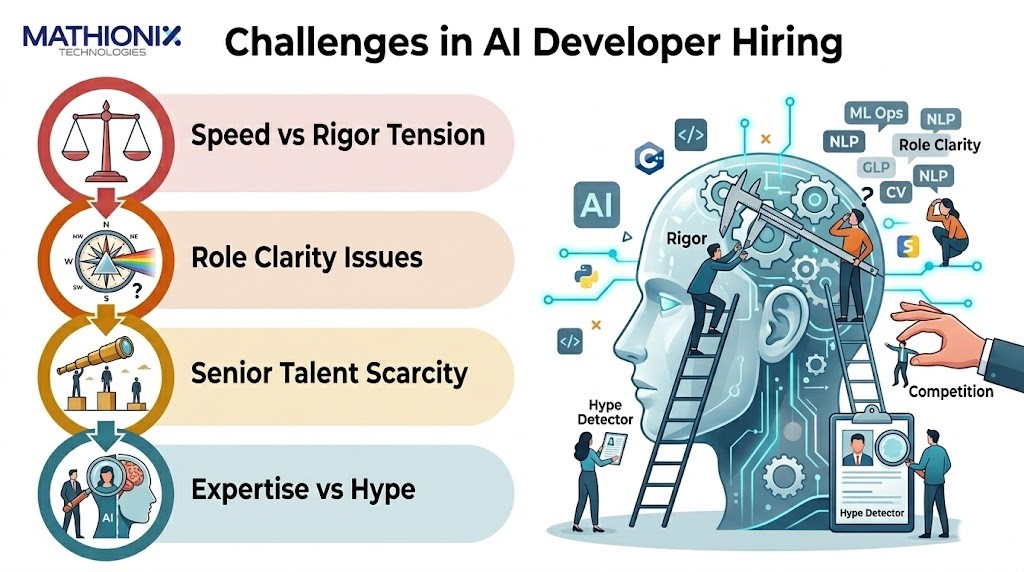
Understanding where hiring typically breaks down helps you avoid the traps most companies fall into.
1. Speed vs. Rigor Tension
When there’s pressure to ship, hiring teams cut corners in technical evaluation, which leads to costly bad hires.
Solution: Define your minimum technical bar before the process starts and hold to it regardless of how quickly you want to fill the role.
2. The Problem of Role Clarity
Many companies start hiring AI engineers without a clear picture of what they actually need, leading to mismatched expectations on both sides.
Solution: Write a specific scope document before posting the job that outlines the problem to solve, the tech stack involved, and what success looks like in the first six months.
3. Talent Pool Scarcity at Senior Levels
Senior AI engineers are absorbed fast, often directly from universities by large technology companies, leaving a thin available pool for growing businesses.
Solution: Expand your search to include strong mid-level candidates with clear growth trajectories, or explore global talent networks that give you access to pre-vetted engineers outside the typical hiring pipeline.
4. Identifying Genuine Expertise vs. AI Hype
With AI dominating headlines, a wave of candidates have added AI keywords to their resumes without meaningful experience to back them up.
Solution: Replace abstract interview questions with practical, role-specific assessments that reflect real tasks your AI developer will face from week one.
Types of AI Developer Roles: Which One Does Your Company Actually Need?
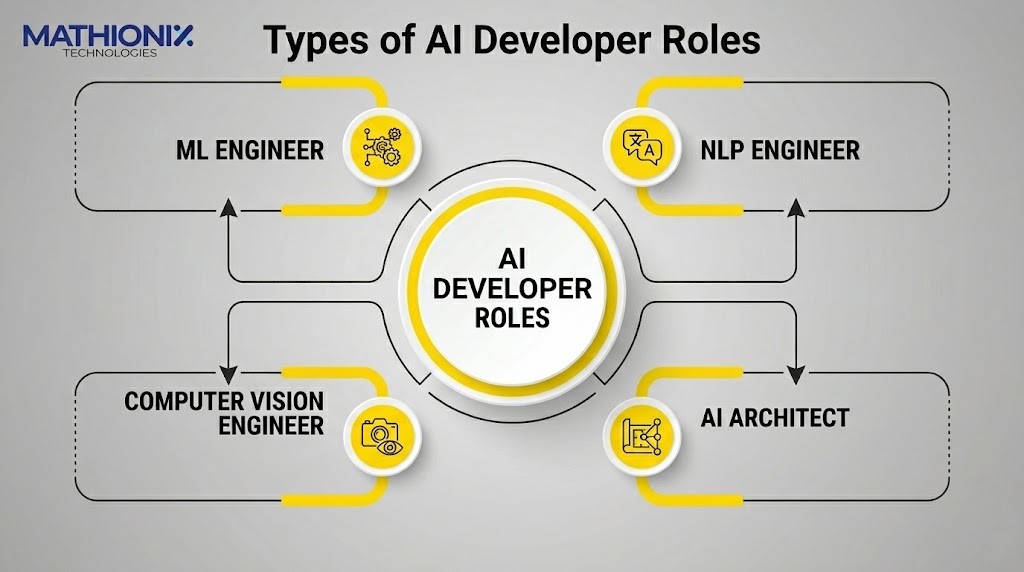
Not every AI hire serves the same function, and hiring the wrong profile wastes time for everyone.
1. ML Engineer
A machine learning engineer builds the systems that train, evaluate, and deploy machine learning models. They sit between data scientists, who do the research, and software engineers, who build applications. Their day-to-day involves writing pipelines, managing model versioning, and ensuring that models that work in testing continue to perform reliably in production. If you’re building predictive features, recommendation systems, or fraud detection capabilities, an ML engineer is typically your first hire.
2. NLP Engineer
Natural language processing engineers specialize in building systems that understand, interpret, and generate human language. This includes everything from search and summarization to chatbots, sentiment analysis, and document classification. With the explosion of large language models over the last few years, NLP has become one of the hottest and most undersupplied specializations in the AI talent market. If your product interacts with text, documents, or voice at any meaningful scale, this is the role you need.
3. Computer Vision Engineer
Computer vision engineers build systems that interpret and analyze visual inputs such as images and video. Use cases include quality inspection in manufacturing, medical imaging analysis, facial recognition, object detection in autonomous systems, and content moderation at scale. This specialization requires strong knowledge of convolutional neural networks and frameworks designed for image processing. It’s a narrower talent pool than general ML, so hiring timelines tend to be longer.
4. AI Architect
An AI architect operates at a higher level of abstraction, designing the overall structure of AI systems rather than implementing individual models. They decide how different components fit together, which infrastructure supports the workload, how data flows through the system, and what standards govern model governance and monitoring. Growing companies typically hire an AI architect once they have multiple AI initiatives in motion and need someone to ensure they’re building coherently rather than patching things together over time.
How Much Does It Cost to Hire an AI Developer?
Budget is usually the deciding factor in how a company structures its AI hiring strategy.
AI roles command 67 percent higher salaries than traditional software positions on average, according to current market data. Here’s a realistic breakdown of what companies are paying across experience levels and regions.
| Experience Level | US-Based (Annual) | India / Southeast Asia (Annual) | Eastern Europe (Annual) |
|---|---|---|---|
|
Junior (0–2 years) |
$90,000 – $130,000 |
$18,000 – $35,000 |
$30,000 – $55,000 |
|
Mid-Level (3–5 years) |
$140,000 – $190,000 |
$35,000 – $60,000 |
$55,000 – $85,000 |
|
Senior (5+ years) |
$200,000 – $285,000 |
$60,000 – $95,000 |
$85,000 – $130,000 |
|
AI Architect |
$250,000 – $350,000+ |
$80,000 – $120,000 |
$100,000 – $160,000 |
These figures reflect base salary only. For US-based hires, add 20 to 30 percent for benefits, equity, and overhead. For international hires, factor in contractor management costs or employer-of-record fees if you’re hiring through a structured global talent model.
For growing companies watching their burn rate, working with a global AI talent partner can reduce total hiring costs by 50 to 70 percent compared to US-based hires, without sacrificing the technical quality you need to move fast.
Stepwise Process for Hiring AI Developers
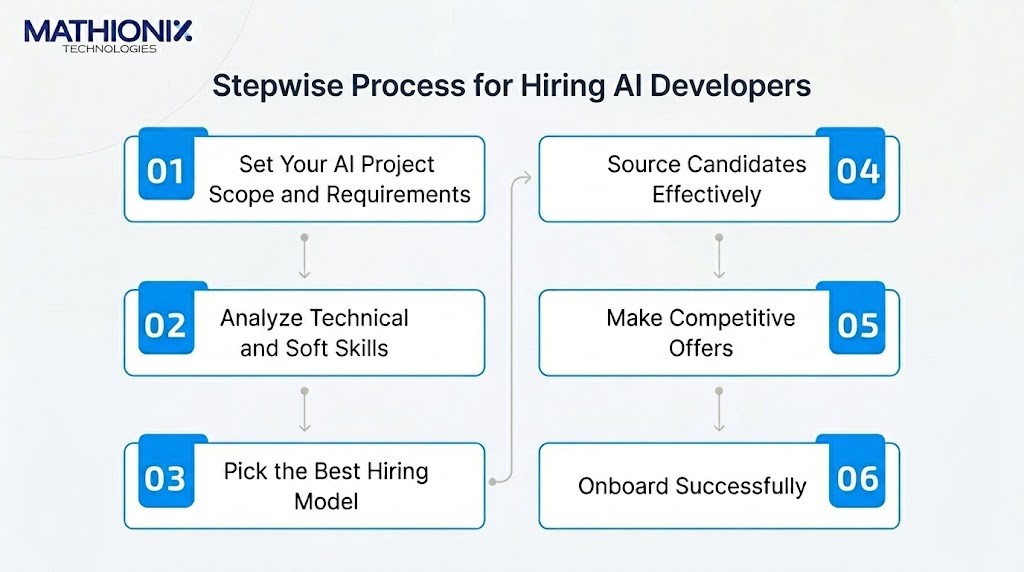
A structured approach removes guesswork and shortens time-to-hire significantly.
1. Set Your AI Project Scope and Requirements
Before posting any job, document specifically what the AI developer will build and what success looks like in measurable terms. Vague goals attract vague applicants. A defined scope makes technical screening faster and far more accurate.
2. Pick the Best Hiring Model
Decide upfront whether you need a full-time in-house hire, a contract specialist, or a hybrid approach. For early-stage companies, contract or global talent is often faster and more budget-friendly. For sustained AI roadmaps, a mix of in-house and external gives you both speed and long-term ownership.
3. Source Candidates Effectively
Standard job boards rarely surface the best AI talent. Platforms like GitHub and Kaggle reveal candidates actively contributing to real projects, which is a far better signal than a resume keyword match. Global talent networks and university partnerships are high-yield channels most companies underuse.
4. Analyze Technical and Soft Skills
Use practical assessments that mirror actual work, not abstract puzzles. Review existing project work critically and listen for how clearly candidates explain complexity. An AI developer who can’t communicate with non-technical stakeholders will create alignment problems across your team.
5. Make Competitive Offers
Move quickly when you find someone strong. Structure your offer with learning budgets and meaningful project ownership. Slow, low offers are the fastest way to lose candidates you spent months finding.
6. Onboard Successfully
Prepare environment access and data before day one, assign a technical mentor, and start with a contained but meaningful project. Weekly check-ins during the first month surface blockers early before they become bigger problems.
Conclusion
Hiring AI developers takes more than posting a job and waiting. It takes role clarity, a structured process, and a sourcing strategy that goes beyond the obvious channels. The companies winning at this are the ones that treat AI hiring as a strategic decision, not a reactive one.
At Mathionix Technologies, we help growing companies build AI capability the right way, from defining the right roles to delivering the right technology. Talk to our team today and let’s map out your AI hiring roadmap together.
Grow Your Business with Advanced AI Development by Mathionix



Frequently Asked Questions
How Do I Hire an AI Developer?
Define your project scope, source through channels like GitHub and global talent networks, and screen with role-specific assessments rather than generic coding tests.
Should I Hire Freshers or Experienced AI Developers?
Freshers work for supporting roles with clear guidance. For anything going into production, hire someone with real deployment experience.
What is RPO and How Does It Help with AI Hiring?
RPO means outsourcing part or all of your hiring process to a specialist firm. For AI roles, it brings pre-vetted candidates and cuts time-to-hire from months to weeks.
How Long Does It Take to Hire AI Developers?
Traditional hiring takes two to four months. Working with a specialized talent partner can reduce that to two to four weeks with pre-screened candidates ready to go.
What is the Difference Between AI Developers and Software Developers?
Software developers build applications based on fixed rules. AI developers build systems that learn from data, requiring expertise in machine learning, statistical modeling, and working with uncertainty.