
Software Development Trends
Your Complete Guide to Software Development Trends in 2026

Author- SEO Content Writer
The software industry never really slows down, but 2026 feels different. The pace of change in software development trends this year is reshaping how products are built, deployed, and scaled from the ground up. Businesses that once treated digital transformation as a roadmap item are now treating it as survival. From AI-first software architectures to cloud-native development pipelines, the gap between companies that adopt these trends early and those that wait is widening fast. In this guide, we break down the top 10 software development trends in 2026, what makes each one worth your attention, the real benefits they deliver, and how companies are already putting them to work.
Top 10 Software Development Trends in 2026
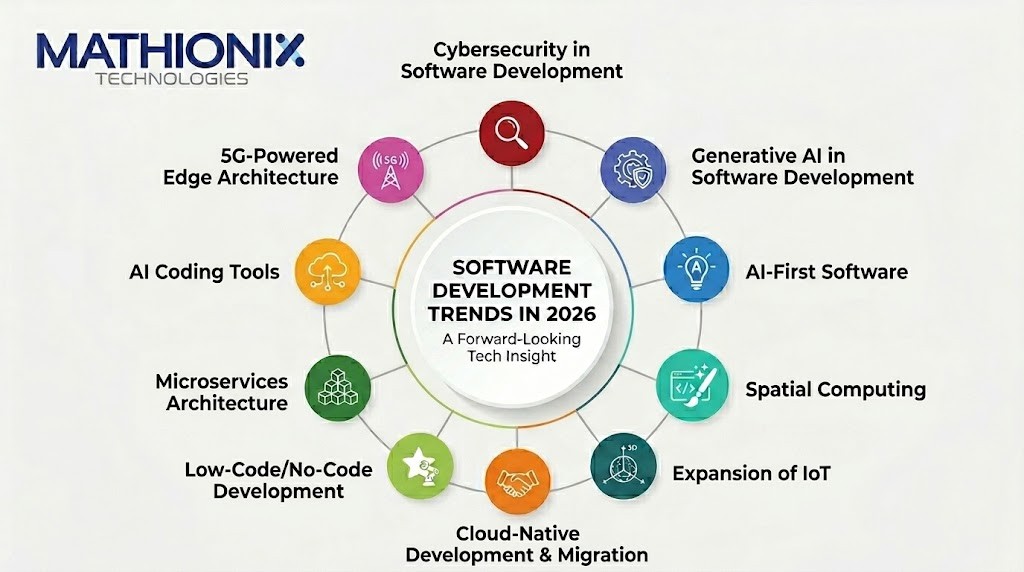
Here is a closer look at the trends defining how modern software gets built this year.
1. Low-Code/No-Code Development
Not every great product idea comes with a team of fifty engineers behind it. Low-code and no-code development platforms are closing that gap by letting teams build functional, production-ready applications through visual drag-and-drop interfaces, pre-built components, and automated code generation. What started as a tool for simple internal apps has matured into a serious development approach with microservices support, deep integration capabilities, and even AI-assisted workflows built in.
Benefits: Low-code development dramatically shortens time-to-market, which matters when your competitors are shipping weekly. It also reduces dependency on scarce developer resources, allowing product and operations teams to move independently on smaller builds. According to Gartner, low-code platforms are projected to account for more than 65% of application development activity by 2025, a trend that has only accelerated into 2026.
Real-world example: Schneider Electric, a global energy solutions provider, used a low-code platform to deliver more than 60 internal applications in just 20 months, saving over 650 developer working days in the process. That kind of output would have been impossible with traditional development cycles.
2. Cybersecurity in Software Development
Cybersecurity is no longer something you bolt onto a product after launch. In 2026, teams are embedding security practices directly into the development lifecycle, an approach commonly known as DevSecOps. Automated threat detection, AI-driven vulnerability scanning, and security testing within CI/CD pipelines are becoming standard practice rather than optional add-ons. The cost of ignoring this is simply too high as data breaches now average over $4 million per incident according to IBM’s annual Cost of a Data Breach report.
Benefits: Catching vulnerabilities early in the development process is exponentially cheaper than fixing them post-deployment. Automated security checks also mean teams don’t have to choose between speed and safety, both can coexist in a well-structured pipeline.
Real-world example: A major financial services company integrated automated static code analysis into every pull request. The result was a 60% reduction in security-related incidents within the first year, without adding headcount to the security team.
3. AI-First Software

There is a meaningful difference between software that uses AI as a feature and software that is designed with AI at its core from day one. AI-first software development means the entire product architecture, data pipelines, decision logic, and user experience are engineered around intelligent systems rather than retrofitting AI into an existing product. Global spending on AI-centric systems is expected to surpass $300 billion in 2026 according to IDC, which signals just how central this approach has become across industries.
Benefits: AI-first architecture allows products to continuously improve through real usage data, making the product smarter over time rather than requiring manual updates. It also enables predictive capabilities that rule-based systems simply cannot match, from fraud detection in finance to predictive maintenance in manufacturing.
Real-world example: A healthcare software provider built an AI-first diagnostic support tool that analyzes patient records, lab results, and imaging data together. Physicians using the tool reported faster differential diagnosis times and flagged fewer critical misses compared to traditional review workflows.
4. Generative AI in Software Development
Generative AI has moved well past the hype cycle and into daily developer workflows. AI software development tools that generate code, write documentation, suggest refactors, and auto-complete complex functions are now used by millions of developers worldwide. GitHub’s own research showed that developers using AI coding assistance complete tasks up to 55% faster than those who don’t, a productivity gain that compounds across large engineering teams. The implications for ai software development go beyond speed, they change what a small team can realistically build.
Benefits: Generative AI reduces the cognitive load on developers by handling boilerplate code, test generation, and routine documentation. This frees up engineering bandwidth for architecture decisions, complex problem-solving, and the kind of work that actually requires human judgment.
Real-world example: A mid-sized SaaS company integrated a generative AI development tool into their engineering workflow and reported a 40% reduction in the time spent writing unit tests, enabling their team to ship features with better test coverage than before, not worse.
5. Spatial Computing
The conversation around immersive technology has matured significantly. Spatial computing, which combines augmented reality, mixed reality, and 3D interaction into coherent development frameworks, is now a legitimate enterprise software trend rather than a novelty. The release of spatial computing headsets from multiple hardware vendors has created a real platform for developers to target, and industries like manufacturing, training, architecture, and retail are leading early adoption.
Benefits: Spatial computing enables use cases that flat-screen interfaces simply cannot support, such as hands-free guided assembly on a factory floor or immersive product visualization in retail. For enterprise software, this translates into measurable improvements in task accuracy and training retention.
Real-world example: An industrial equipment manufacturer deployed a spatial computing training application that overlays step-by-step assembly instructions directly onto the physical equipment. New technician onboarding time dropped by 35% compared to manual-based training.
6. Expansion of IoT
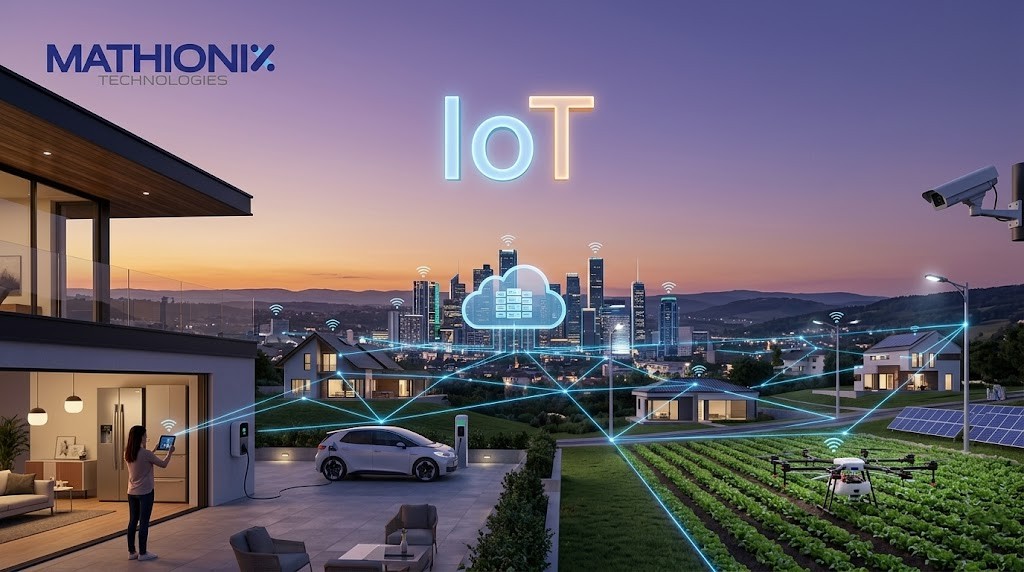
The Internet of Things continues to expand its footprint in 2026, and the software layer behind it is becoming increasingly sophisticated. The number of connected IoT devices globally is projected to exceed 29 billion by 2030 according to Statista, and a significant portion of the software development work required to support them is happening right now. Smart buildings, connected healthcare devices, industrial sensors, and agricultural monitoring systems are all generating data that needs real-time processing, secure transmission, and actionable insight.
Benefits: IoT-connected software gives businesses visibility into operations that were previously invisible. For manufacturers, this means predictive maintenance instead of reactive repairs. For healthcare, it means continuous patient monitoring outside of clinical settings, expanding care access without proportionally expanding cost.
Real-world example: A logistics company deployed IoT sensors across their cold-chain fleet and built a custom monitoring platform on top of the data stream. Spoilage incidents dropped by 28% in the first operational quarter, directly protecting perishable cargo value.
7. AI Coding Tools
AI coding tools deserve their own spotlight separate from generative AI broadly because they are fundamentally changing how individual developers work day-to-day. These tools now go beyond autocomplete, they understand context across entire codebases, suggest architectural improvements, detect potential bugs before runtime, and integrate directly into the development environment. Adoption is accelerating rapidly, with surveys showing over 70% of professional developers now using at least one AI tool for software development in their regular workflow.
Benefits: AI coding tools reduce the time developers spend context-switching between documentation, Stack Overflow, and their editor. They also help less experienced developers produce higher quality code earlier in their careers, which compresses onboarding time and raises the overall quality floor across a team.
Real-world example: An enterprise software team reported that after introducing an AI coding assistant across their 30-person engineering org, their code review cycle time dropped by nearly half, because the AI was catching a significant portion of common issues before the human review even began.
8. Microservices Architecture
Monolithic applications made sense when software deployment was infrequent and teams were small. Neither of those conditions applies to most modern software organizations. Microservices architecture, where applications are broken into small, independently deployable services that communicate through APIs, has become the dominant pattern for teams that need to scale both their software and their engineering organization simultaneously. This approach is especially powerful when combined with cloud-native development practices.
Benefits: Microservices allow teams to deploy individual services independently, meaning a bug in one area of the application does not require a full system rollout to fix. It also makes horizontal scaling straightforward since resource-intensive services can be scaled without scaling the entire application.
Real-world example: A high-growth e-commerce platform migrated from a monolithic architecture to microservices ahead of their peak sales season. During the highest traffic day on record, their checkout, inventory, and recommendation services scaled independently without a single site-wide outage.
9. Cloud-Native Development & Migration

Cloud-native development is not simply about hosting your application in the cloud. It means designing software from the ground up to take full advantage of cloud infrastructure, using containers, dynamic orchestration, automated scaling, and managed services as first-class architectural choices. Cloud migration continues at pace in 2026, but the more interesting story is in organizations that are building net-new products with cloud-native principles rather than just lifting-and-shifting legacy systems.
Benefits: Cloud-native applications are inherently more resilient, more observable, and easier to update than their traditional counterparts. They also give engineering teams the ability to iterate faster because infrastructure complexity is abstracted away, letting developers focus on product logic.
Real-world example: A regional insurance provider rebuilt their claims processing platform as a cloud-native application. Processing time per claim dropped from an average of three days to under four hours, and the platform scaled seamlessly during catastrophic weather events that historically overwhelmed their previous system.
10. 5G-Powered Edge Architecture
5G is not just a faster phone network. For software developers, it is the infrastructure layer that makes edge computing practical at scale. Edge AI, where computation happens on or near the device rather than in a centralized data center, becomes dramatically more viable when the network connecting those devices is fast, low-latency, and widely available. Industries like autonomous vehicles, real-time manufacturing, and smart city infrastructure are the most active early adopters of 5G-powered edge architecture.
Benefits: Processing data at the edge rather than sending everything to the cloud reduces latency to near-zero for time-sensitive operations. It also reduces bandwidth costs and keeps sensitive data closer to its source, which has meaningful compliance and privacy implications in regulated industries.
Real-world example: A smart manufacturing facility deployed edge AI nodes on their production floor, connected via a private 5G network. Real-time defect detection improved to 99.1% accuracy, with decisions made in under 10 milliseconds, fast enough to stop a production line before a faulty unit passed quality control.
Conclusion
The software development trends shaping 2026 share a common thread: they are all about doing more with better architecture, smarter tools, and faster feedback loops. Whether your organization is exploring low-code platforms to accelerate internal tooling, adopting AI coding tools to raise engineering productivity, or investing in cloud-native infrastructure to support growth, the direction is clear. Standing still is the only genuinely risky option. The companies getting the most value from these trends are not necessarily the largest ones. They are the ones that move with intention, pick the right problems to solve, and build with the future in mind.
If you are looking for a technology partner to help you navigate these shifts, Mathionix Technologies brings the expertise to turn these trends into real product outcomes for your business. Visit mathionix.com to start the conversation.
Grow Your Business with Advanced Software Solutions by Mathionix

Frequently Asked Questions About Software Development Trends
What is the role of AI tools in software development?
AI tools help developers write code faster, catch bugs earlier, and automate repetitive tasks like testing and documentation, allowing engineering teams to focus on higher-value problem-solving.
What are the latest trends in software development?
The biggest software development trends in 2026 include AI-first software design, generative AI in development workflows, cloud-native architecture, low-code platforms, and 5G-powered edge computing.
What is the latest technology in software development?
Generative AI coding tools, spatial computing frameworks, and edge AI infrastructure are among the most actively adopted new technologies in software development right now.
What is the future of software development?
The future of software development points toward AI-augmented engineering, where developers work alongside intelligent tools, and toward architectures that are cloud-native, distributed, and built to adapt continuously.
How do you stay updated on new software technologies and industry trends in software development?
Following engineering blogs from major cloud providers, subscribing to developer-focused research reports, and engaging with open-source communities are the most reliable ways to stay current with emerging software development technologies.
What is generative AI in software development?
Generative AI in software development refers to AI systems that can produce code, suggest refactors, write tests, and generate documentation based on natural language prompts or existing code context, accelerating the entire development lifecycle.